Legacy platforms in wealth management: Why five years is already too long
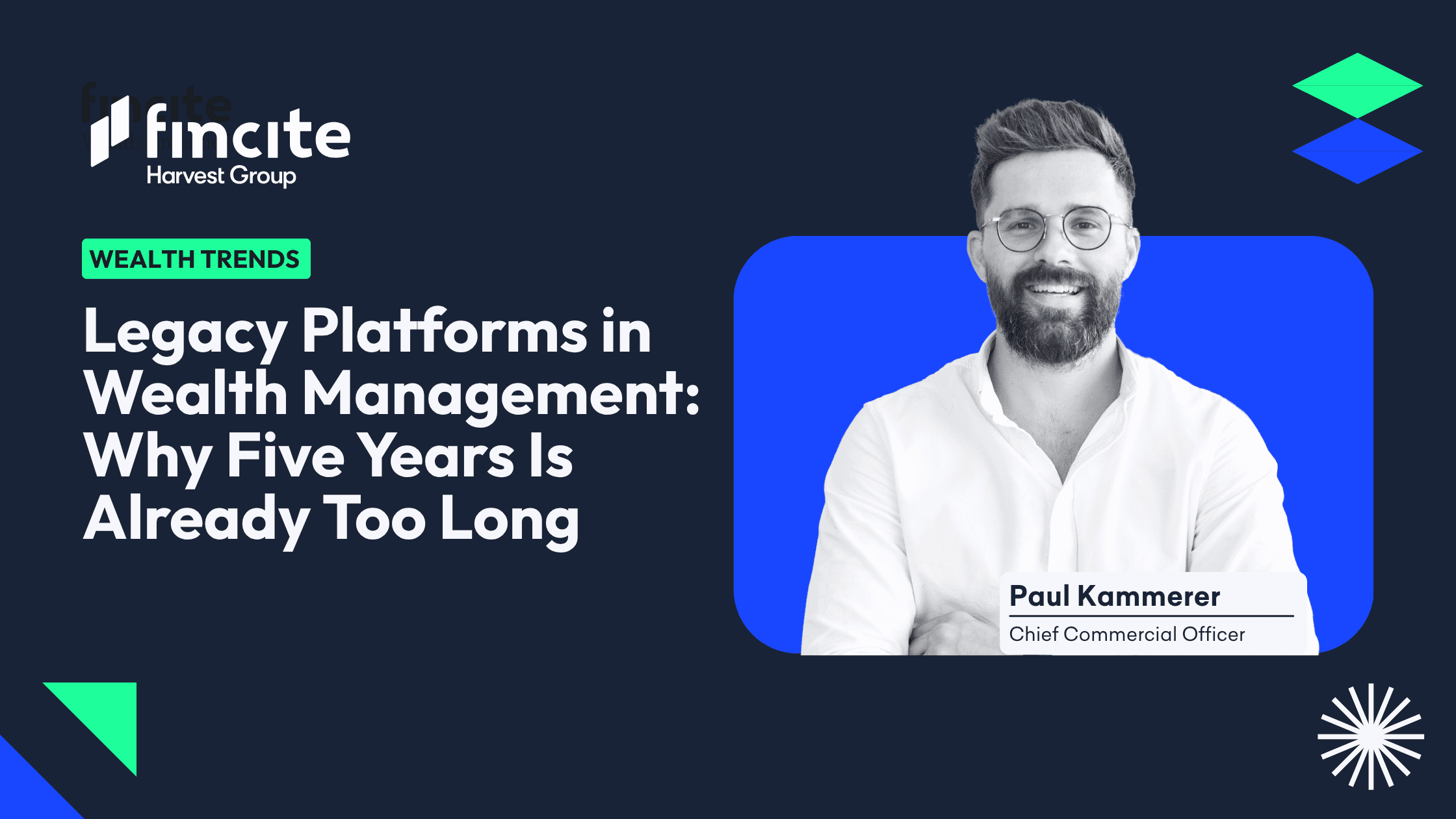
Paul Kammerer
Legacy Platforms in Wealth Management: Why Five Years is Already Too Long
An uncomfortable truth is circulating among the CIOs of leading private banks: anyone who built their core platform five to seven years ago as a bespoke solution is likely running legacy infrastructure today. Not in the classical sense of decades-old mainframes. But legacy in the only sense that still matters in 2026: too slow to remain competitive.
This is not a judgment on past decisions. It is a description of market velocity.
What "Legacy" Really Means in Wealth Management Today
Legacy no excuse longer means that a system is old. It means that it no longer reacts quickly enough to change.
The wave of digitalisation over the last 15 years has profoundly changed the industry. The AI wave currently reshaping wealth management is moving faster. Platforms built for a world where "digital" meant having a mobile app are not equipped for this world.
In this context, tech debt is not an abstract IT problem. It costs advisor time, client satisfaction and regulatory security. Every hour an advisor spends transferring data between systems or manually creating compliance documentation is an hour not spent with the client.
The Amazon Effect Has Reached Private Banking
Private investors no longer compare their bank with other private banks. They compare it with Amazon, Netflix and any consumer technology that delivers instant results.
If a client can order a luxury vehicle and have it delivered within 48 hours, a three-day process for consolidated portfolio reporting feels like a step backwards from another era.
The concept behind this is simple: time-to-value. Every interaction, from onboarding to portfolio rebalancing, must deliver immediate results. Competitors who can do this win mandates before the first conversation even ends. Retail brokers and neobanks are already penetrating the private banking segment. They appeal to digital beginners and the next generation of heirs, the exact clients traditional institutions risk losing.
Three Questions Every Private Bank Should Answer
Three concrete questions help assess where a platform stands today:
1. Can new investors be onboarded digitally in under 48 hours, including electronic signatures? If not, mandates are lost before the first meeting ends. Leading institutions achieve digital onboarding in under seven minutes today.
2. Does the deployed AI work with full client context? That means: consolidated assets across multiple custodians, real estate assets, alternative investments, sustainability preferences, family situation and wealth transfer goals. Without this context, AI produces impressive outputs that achieve nothing in practice.
3. Does the platform support the advisor or does it interrupt them? If an advisor turns their laptop during a client meeting to show portfolio analytics, physical distance is created, the flow of conversation breaks down, and the emotional connection decreases. Technology should disappear during the advisory meeting, not stand in the foreground.
For most private banks, at least one of these answers is uncomfortable.
Why Generic AI Fails in Wealth Management
Most private banks are experimenting with AI. Many fail in identical ways.
They deploy powerful models trained on vast datasets and then wonder why the results feel generic, irrelevant or actively unusable. The problem is not the model. It is the lack of context.
A recommendation engine that knows a client's risk profile but not their family dynamics, cross-border tax liabilities or wealth transfer goals across three generations produces expensive noise. Real value is only created when AI has access to complete client information.
This is exactly where most implementations fail. Banks add AI features to their existing platforms that were never built to centralise this depth of information. The result: technically impressive, practically ineffective.
According to an analysis by Microsoft, financial institutions using modern platforms experience 75% less time searching for information, accompanied by a nine percentage point increase in employee satisfaction. These are not marginal improvements. These are competitive advantages.
What a Platform Needs for Continuous Evolution
The strategic choice is clear: either platforms are built for continuous evolution, or the competitive position erodes further with every technology cycle.
What this means in concrete terms:
Compliance as part of the workflow, not as an additional task. MiFID II suitability checks, full audit trails, portfolio suitability for discretionary mandates: those who catch up on compliance manually lose advisor time and risk regulatory violations.
Real-time portfolio monitoring instead of periodic evaluation. Systems that continuously measure portfolio drift and proactively signal the need for action ease the burden on advisors and strengthen the quality of advice.
AI that prepares decisions, not just answers questions. Before an advisor opens a quarterly review file, AI should have already identified relevant stress-test scenarios, highlighted portfolio concentrations and prepared rebalancing options.
Modular architecture that integrates new features without requiring complete platform rebuilds.
fincite • cios is built exactly for this model as a modular wealth management platform. Over 9,000 advisors use the platform today, with a proven 80% reduction in investment constraint violations and 12 weeks saved per advisor per year.
Conclusion: The Decision Cannot Be Deferred
Legacy platforms in wealth management are not an IT problem. They are a strategic competitive problem that grows larger every day.
Innovation cycles are shortening. The AI wave currently reshaping wealth management is moving faster than anything before it. Valuation processes running on platforms from 2019 or earlier are not just behind the state of the art; they are being left further behind every day.
The question is not whether transformation is necessary. The question is whether your firm leads it or gets overtaken by it.
Would you like to know where your platform stands today? Speak with our WealthTech experts and find out which steps are realistic and concretely implementable for your institution.
This article addresses topics that Paul Kammerer, CCO and Managing Director of fincite, analyses in detail in a piece for the Spring 2026 issue of Mosaic Magazine by The Wealth Mosaic. The magazine gathers perspectives from WealthTech experts across Europe on the defining trends of the industry.