WealthTech Radar 2026: AI in Wealth Management
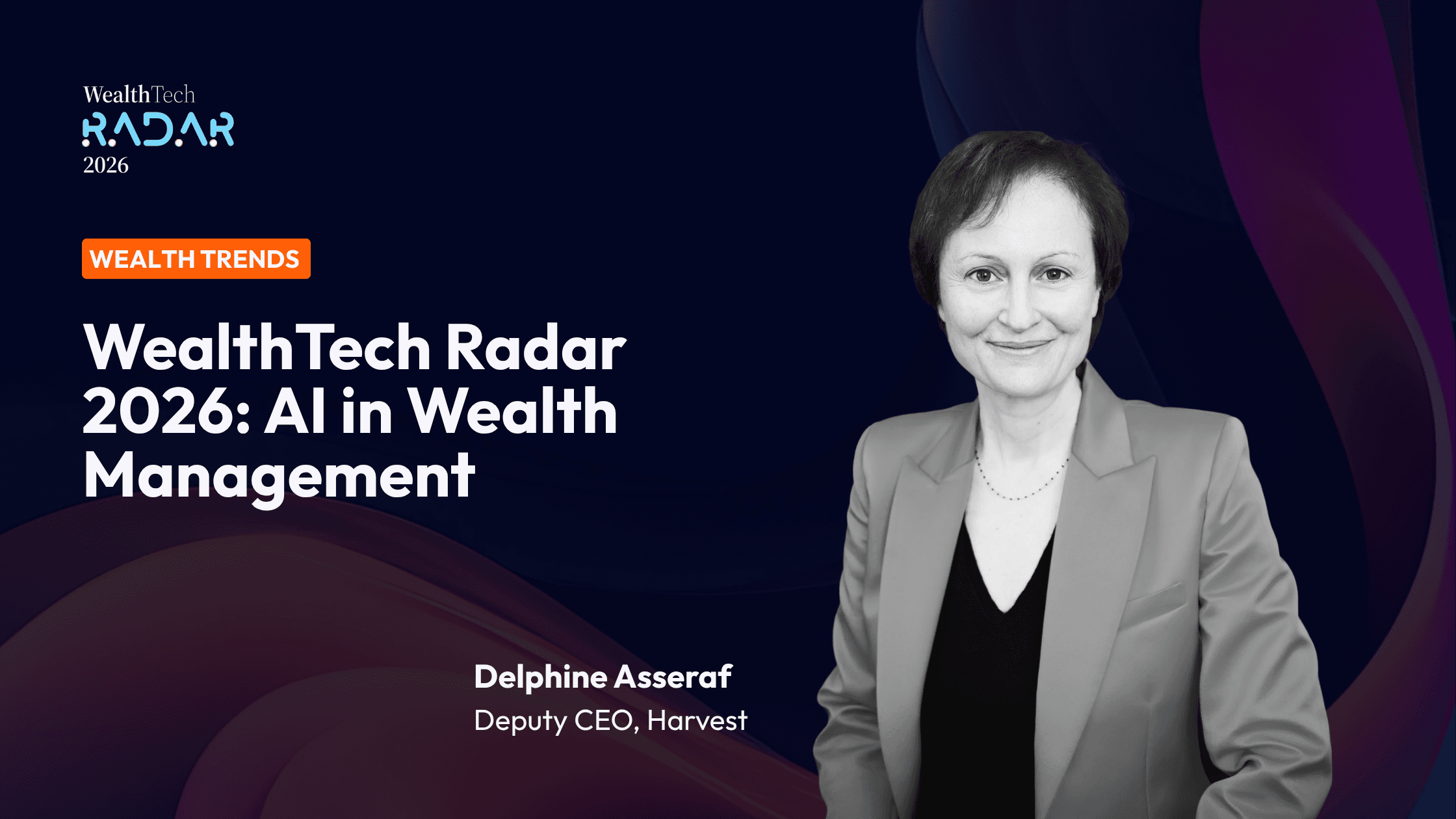
Delphine Asseraf
81% of companies see AI as the most important technology of the future. Only around 25% of financial institutions already use it as a genuine competitive advantage. This gap has a name, and it costs the industry more than just time.
What is AI in wealth management?
Artificial intelligence in wealth management includes machine learning and generative AI across the entire value chain: from research and portfolio construction to personalised recommendations and next-best action, fraud detection and regulatory support, through to relieving relationship managers of administrative tasks. The result is more individualised, faster and more consistent advisory services, embedded in solid governance and robust data processes.
Why this topic is more relevant than ever in 2026
8 out of 10 companies (81%) now regard AI as the most important technology of the future. At the same time, for the first time, a slim majority (51%) believes that companies without AI have no future. And yet: only 35% of intermediaries in financial advisory actively use AI tools such as ChatGPT, and only 10.5% do so daily (AfW Intermediary Barometer 2024/2025; Bitkom, 2025).
At company level, only around 25% of financial institutions have scaled AI in such a way that it generates a measurable competitive advantage. The rest remain stuck in pilot projects. BCG positions AI as the engine of the next generation of banking and warns: "pilot-itis" is no longer enough. What is needed are scaled, earnings-relevant applications (BCG, "For Banks, the AI Reckoning Has Arrived", May 2025).
At the same time, the balance of power is shifting: neobrokers and non-bank providers benefit from superior tech stacks and can realise AI value more quickly. Banks must therefore build targeted partnerships and purpose-built AI at infrastructure level.
A look at the market: expectations outpace implementation
Europe is acting more cautiously than the US or Asia. This is shown by the findings of the Capgemini World Wealth Report 2025 on the digital-first expectations of the next HNWI generation and under-equipped relationship managers. Everyday hurdles are high: companies cite a lack of technical know-how (53%) and staff shortages (51%) as key obstacles. Legal uncertainty is also cited as a major brake. The path to scaled adoption runs through clean data foundations, clear responsibilities and model governance by design.
Agentic AI, meanwhile, is maturing rapidly: Gartner expects that by 2026, task-specific agents will be used in 40% of all enterprise applications, acting as a catalyst for integrating AI directly into RM desktops and accelerating front-to-back processes (Gartner, August 2025).
Developments in past WealthTech Radars
WealthTech Radar 2023: AI as a clear efficiency lever. Automation and seamless integrations can massively increase the number of productive advisory conversations.
WealthTech Radar 2024: Sharpening of value areas: better forecasts, personalised client profiles, more efficient compliance management and noticeable RM relief. Caveat: "80% of the value" comes from the right data. Rollout in Germany remains slow.
WealthTech Radar 2025: AI is established as a service category, but the gap between big promises and still disappointing user experience, especially in the "low seven-figure" segment, remains.
The reality at the RM desk
The next generation of HNWIs expects digital, tailored interactions. 71% of WM executives see "digital-first" as a decisive retention factor. At the same time, not all relationship managers have the necessary tools: only around half of WM firms provide their RMs with AI-supported profiling and behavioural analytics. Two out of three offer digital tools for real-time portfolio insights (Capgemini World Wealth Report 2025).
The strategy exists on paper. The reality at the adviser’s desk still looks different.
Critical assessment: demand is clear, implementation is fragmented
Demand is clear, delivery capability is often fragmented. Without data quality, identity and authorisation models, and end-to-end model controls (registries, tests, monitoring), ROI will fall short of expectations.
BCG shows: only a quarter of institutions currently use AI as a genuine competitive advantage. Successful firms consistently align AI with measurable earnings ("high-ROI banks") and do not deploy technology for its own sake. Capgemini simultaneously confirms the gap between customer expectations and RM enablement.
The lesson: governance, data and integration into day-to-day business are not "nice-to-haves", but prerequisites for scaling.
What banks should do now
Secure short-term value. Start with P&L-adjacent front-to-back use cases: RM co-pilot (dossiers, research syntheses, meeting preparation), next-best action across the entire client lifecycle, automated suitability and appropriateness checks with documented explainability.
Industrialise the data foundation. A wealth data layer with clearly defined responsibilities for master, transaction, portfolio and interaction data forms the basis for hyper-personalisation and robust models. This includes EU-compliant governance: an AI/DORA-compliant control framework with model registry, evaluation pipelines, prompt/output checks, incident playbooks and third-party risk management.
Leverage partnerships. Use infrastructure and data partnerships with fintechs where time-to-value is critical, without relinquishing the control function.
Conclusion
"AI does not replace people. It enhances their decision-making capability."
— Delphine Asseraf, Deputy CEO, Harvest
AI does not replace the wealth manager, but it replaces those who do not use it. The real value lies in the combination of human and machine: the "AI-enabled adviser" understands the emotional nuances and complex life situations of clients, while AI delivers precise, unbiased, data-driven decisions and compliance.
Those who now close the gap between "wanting to" and "being allowed/able to", with reliable data, clear governance and agent-ready journeys, will transform digital-first into "advice-first" and hold their ground against neobrokers.
This article is based on the chapter "AI in Wealth Management" from the WealthTech Radar 2026, written by Delphine Asseraf, Deputy CEO at Harvest. The full report with 11 trends and analyses by 12 industry experts is available as a free download.